
Hungary Golden Visa Ending in 2027? What the Draft Bill Says

Hungary Golden Visa Ending in 2027? What the Draft Bill Says
Under a draft bill the Hungarian government published on 4 November 2026, the guest investor visa and residence permit, known as Hungary’s golden visa, would be phased out from 1 January 2027. If you want to apply under the current rules, the draft sets one hard date. Your application must be filed and its fee paid by 31 December 2026. Permits already issued would stay valid for their term, but none could be extended. The bill is a draft, not law.
Status as of 9 November 2026: draft bill, public consultation open until 12 November 2026, not yet before Parliament, no vote date set.
Last updated: 9 November 2026.
This article is general information about a draft Hungarian bill and the guest investor rules currently in force. It is not legal, tax or immigration advice. The draft can change before it is adopted, and individual circumstances differ. Obtain independent professional advice before making any application or investment decision.
Key facts at a glance
| Date or rule | What the draft says |
|---|---|
| 4 November 2026 | Draft published for public consultation on kormany.hu, inside a wider bill amending law enforcement legislation |
| 12 November 2026 | Consultation closes. The bill is not yet in Parliament |
| 31 December 2026 | Applications filed with the fee paid by this date would be decided under the rules in force on 31 December 2026 (draft s.290/A(1), (2)) |
| 1 January 2027 | The phase-out provisions would take effect (draft s.211(2)) |
| Existing visas and permits | Valid for their term. No guest investor permit can be extended (s.290/A(3), (5)) |
| Visa-free nationals | The in-Hungary application route would close on 1 January 2027 (s.290/A(9)) |
| Family permits | Up to 10 years, no extension beyond that, and not beyond the investor’s permit (s.290/A(3)(b), (6); s.73(2)) |
| Work rights | Kept for the life of the permit, for holder and family (s.290/A(13)) |
| Programme use to date (OIF data, not the draft) | 314 approved visa decisions and 228 approved permit decisions, 1 July 2024 to 30 September 2026 |
What must you do by 31 December 2026?
The deadline is about applications, not investments. Under the draft, an application counts as submitted only if its administrative fee has been paid by 31 December 2026 (s.290/A(2)). “Paid” is not defined, so leave a margin of several working days for transfers.
| If you are… | What must be in by 31 December 2026 | What can follow later |
|---|---|---|
| Applying at a Hungarian consulate (nationals who need a visa) | The guest investor visa application, with proof of investment or a written commitment, a bank certificate and proof of the lawful origin of funds, and the fee | The investment can follow while the six-month visa is valid. You can file for the permit after 1 January 2027 while holding a valid visa, within 30 days of first entry (s.290/A(4); s.22(5)) |
| A visa-free national applying inside Hungary (for example US, Canadian, Australian, Israeli, UAE or Brazilian citizens) | The residence permit application and its fee. Under the draft this route would close on 1 January 2027 | Under current law you file within 30 days of first entry and prove the investment within six months of first entry (s.22(5), (7)) |
| Already holding a guest investor permit | Nothing new is required by the draft | Your permit runs to its expiry date unless withdrawn, and cannot be extended |
For visa-free nationals filing online, OIF counts an application as received only once the fee is paid and biometrics are given within 15 days. Whether biometrics given after 31 December would still count is not settled, so pay the fee and complete every filing step, including biometrics, well before 31 December. The draft is also unclear on whether a visa-free national holding a guest investor visa could file in 2027, so treat 31 December as your hard date either way.
There is no official lead time for this process. As a planning judgement, not a legal deadline, we suggest starting by about 20 November and aiming to file by 15 December, because evidencing the source of funds takes time and appointment availability around the year-end holidays is hard to predict. Our 31 December 2026 deadline guide walks through both routes step by step.
Is the Hungary golden visa ending?
Not yet. The programme is open today under Act XC of 2023. A draft bill would, if Parliament adopts it as written, remove the guest investor visa and permit from Hungarian law from 1 January 2027. Interior Minister Gábor Pósfai announced the phase-out on Facebook late on 4 November 2026 (MTI via Index, 5 November). The official reasons state the aim as removal from the legal system while protecting acquired rights, and give no other reason.
It is not a suspension. Some reports use that word, but the draft does not pause or postpone the route. It would phase it out, with transition rules for applications filed and paid by 31 December 2026.
What does the draft bill actually say?
The proposal sits in a long bill on law enforcement matters (egyes rendészeti tárgyú törvények módosításáról), in the subtitle that amends Act XC of 2023. Three sections matter.
- Section 181 replaces the existing section 290/A of Act XC of 2023 (today a transitional rule from the December 2024 reform) with a new set of transitional rules for the guest investor visa and permit (vendégbefektetői vízum, vendégbefektetői tartózkodási engedély). The draft’s explanatory reasons call this “kivezetés”, a phase-out.
- Section 182 would repeal the current guest investor provisions, including section 22 and section 227 of the Act.
- Section 211(2) would set 1 January 2027 as the commencement date for these changes.
Beyond the dates in the key facts above, the new section 290/A would also do three things. Applications decided under the transition rules would apply the current section 16 and section 22, including the investment conditions (290/A(7), (8)). Visa-free nationals would be defined by Annex II of Regulation (EU) 2018/1806 (290/A(9)). And the permit would have to be withdrawn on the general grounds in section 226(1)(a) to (c), or if it can be shown that the committed investment no longer exists (290/A(11)).
What happens to visas and permits already issued?
They would stay valid for their term. A permit can be issued for up to 10 years today, and current law allows an extension of up to 10 more (s.22(6)). The draft would remove that extension for every permit, including permits already issued, and would create no replacement status at the end of the term. The draft is not clear on whether an extension application pending on 31 December 2026 could still be granted, and we do not assume it would.
The draft leaves the long-term residence rules untouched, and this permit is not excluded from them (s.83(5)). The national permanent residence card normally needs three years of continuous lawful stay (no absence over four months, no more than 270 days away in total), a cultural exam, a clean record and an assessment of Hungary’s interests (s.83, 84, 253/A). The EU long-term residence card needs five years of continuous stay and an exam (s.87). Neither is automatic, and the residence-based grounds require genuine residence in Hungary. See our guide to Hungary permanent residency.
Our guide for existing permit holders covers family permits, fund units and work rights in more detail.
How many guest investor visas has Hungary approved?
In answers to two public interest data requests, OIF, Hungary’s immigration authority, gave its guest investor figures. The answers cover 1 July 2024 to 30 September 2026, 27 months without a gap. The figures count decisions, not people. One person can appear in both the visa and the permit tables, and visas and permits are separate counts.
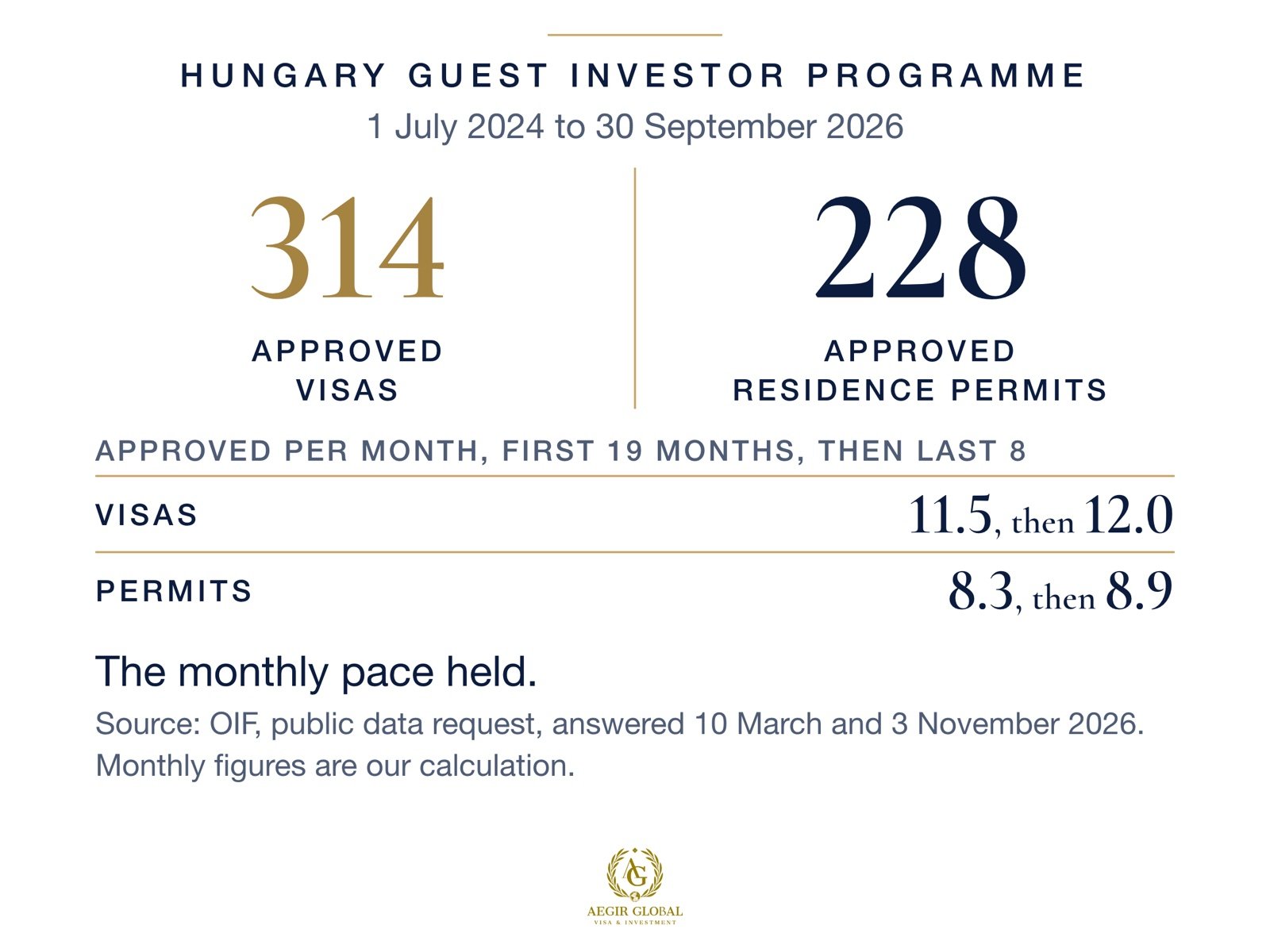
Approved decisions. OIF recorded 314 approved guest investor visa decisions and 228 approved guest investor residence permit decisions in the period. The monthly pace was similar in OIF’s two reporting periods. Approved visas ran at 11.5 a month in the first 19 months and 12.0 a month in the last 8, and approved permits at 8.3 and then 8.9 a month (our calculation).
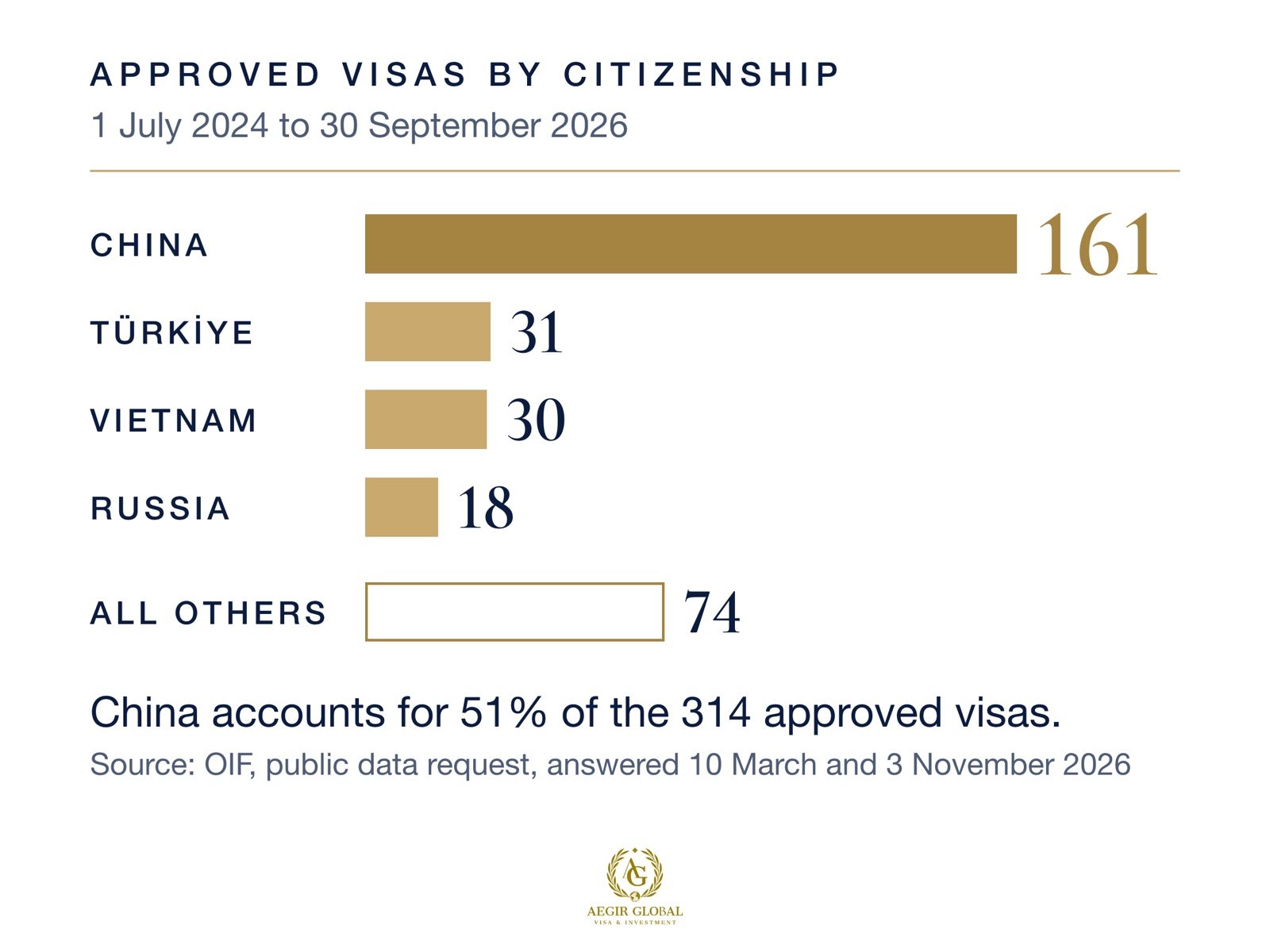
By citizenship. Chinese citizens account for 161 of the 314 approved visa decisions, 51% (our calculation). Türkiye follows with 31, Vietnam with 30 and Russia with 18, and all other citizenships together account for 74. OIF records the citizenship stated and verified on the application and holds no data on any other citizenship.
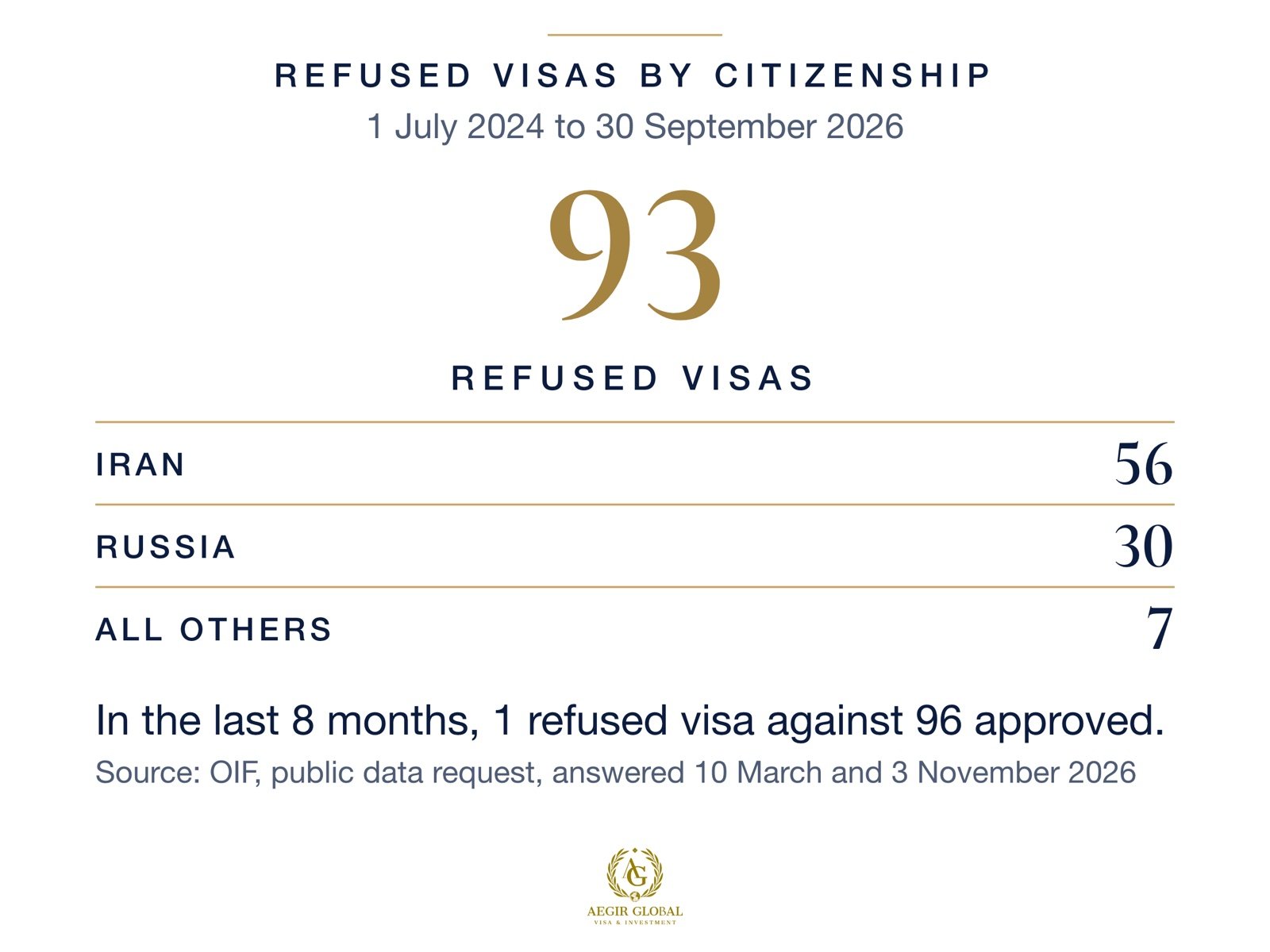
Refusals. OIF recorded 93 refused guest investor visa decisions in the same period: 56 for Iranian citizens, 30 for Russian citizens and 7 for all other citizenships. In the last eight months, February to September 2026, it recorded 1 refused visa decision against 96 approved. Citizenship is again as recorded on the application.
These are past decisions only. OIF’s answers give no reasons for refusals, and the figures say nothing about the outcome of any individual application.
Source: OIF, answers to public interest data requests dated 10 March and 3 November 2026. Monthly figures and percentages are our calculation.
What about family members?
Family means the spouse and minor children, including adopted and foster children and the spouse’s minor children (s.22(14), 71(2)). Under the draft, a linked family permit could run for up to 10 years, never beyond. Family members could still apply for or extend one after 1 January 2027, up to the end of the investor’s permit, because the 31 December test names only investor applications. See Hungary golden visa for families.
What does it cost today, and what are the limits?
The routes in force today are a subscription of at least EUR 250,000 in units of a real estate fund registered with the Magyar Nemzeti Bank, held for at least five years in a blocked sub-account, or a donation of at least EUR 1,000,000 to a higher education institution maintained by a public-interest trust foundation, to support education, research or the arts (s.16(3), 22(9)). Direct purchase of residential property has not been a qualifying route since 30 December 2024 (Act LXXXIV of 2024). Our guide to approved funds explains the fund route.
Before committing EUR 250,000, weigh these limits.
- Filing is not approval. The usual screening and refusal grounds still apply (s.16(4), 224/B).
- The permit runs for up to 10 years and could not be extended under the draft.
- The five-year hold still applies to applications decided under the transition rules (290/A(8)).
- Selling fund units after year five is an open question. Today’s withdrawal trigger refers to the holding period set in the Act (s.227(3)(b)). The draft would repeal section 227 and test only whether the investment “no longer exists”, with no period. We do not say you are free to sell after five years, nor that you must hold for ten.
- Self-employment rights are not expressly saved. The draft keeps the right to work as an employee (290/A(13)) but does not expressly address self-employment or serving as a company director.
Is this law yet, and what happens next?
No. Consultation runs from 4 to 12 November 2026, after which the text can be revised before it goes to Parliament. No submission or vote date has been announced, and the text, including the dates, can change. We track each step on our Hungary golden visa news page and update this article the same day the text moves. If the timetable does not work for you, compare the alternatives to the Hungary golden visa.
Frequently asked questions
Can I still apply for the Hungary golden visa in 2026?
Yes. The programme is open under current law. Under the draft, a new application must be filed and its fee paid by 31 December 2026 to be decided under the current rules, even if the decision comes in 2027.
Do I need to invest before 31 December 2026?
No. On the consulate route you can file the visa application with a written commitment, a bank certificate and proof of lawful funds, and the investment can follow while the six-month visa is valid. If you apply inside Hungary as a visa-free national, the investment must be proven within six months of first entry.
Can I renew my Hungarian guest investor permit after 2027?
Under the draft, no. Permits issued before 1 January 2027 would stay valid for their term, but no guest investor permit could be extended, including permits issued under the transition rules.
How many guest investor visas has Hungary approved?
OIF, Hungary’s immigration authority, recorded 314 approved guest investor visa decisions and 228 approved residence permit decisions between 1 July 2024 and 30 September 2026, in its answers to public interest data requests. These count decisions, not people. Chinese citizens account for 161 of the approved visas.
Does applying by 31 December guarantee approval?
No. Filing on time means the current rules apply. It does not mean approval. Screening and refusal grounds still apply.
What happens if I am a US or Canadian citizen already in Hungary?
Under the draft, nationals of visa-free countries could no longer file a guest investor permit application inside Hungary from 1 January 2027. The application and fee would need to be in by 31 December 2026, and under current law the in-country application must be filed within 30 days of your first entry. Applying for a guest investor visa at a consulate is a separate route, with the same 31 December filing date.
Is the Hungary golden visa suspended?
No. The draft would phase the programme out from 1 January 2027. It does not suspend or postpone it, and the programme is open today.
Sources
- Government of Hungary, draft bill on law enforcement matters, published for public consultation on 4 November 2026 (draft text and reasons): kormany.hu
- Act XC of 2023 on the general rules for the entry and residence of third-country nationals: njt.hu
- National Directorate-General for Aliens Policing (OIF), residence permit for guest investors: oif.gov.hu
- Regulation (EU) 2018/1806, Annex II (visa-free third countries): EUR-Lex
- OIF, answers to public interest data requests dated 10 March and 3 November 2026 (guest investor visa and residence permit decisions, 1 July 2024 to 30 September 2026). Monthly figures and percentages are our calculation.
- Press coverage: MTI via Index (5 November 2026), Portfolio (5 November 2026), IMI Daily (6 November 2026)
For the full picture of the programme as it operates today, see our guide to the Hungarian Guest Investor Programme. To discuss whether a 2026 application fits your plans, speak with an accredited adviser. Advisory fees are quoted per engagement.
Update log
- 9 November 2026: first published. Based on the draft text and reasons published on kormany.hu on 4 November 2026 and on Act XC of 2023 as in force today.
- 9 November 2026: added official OIF figures.